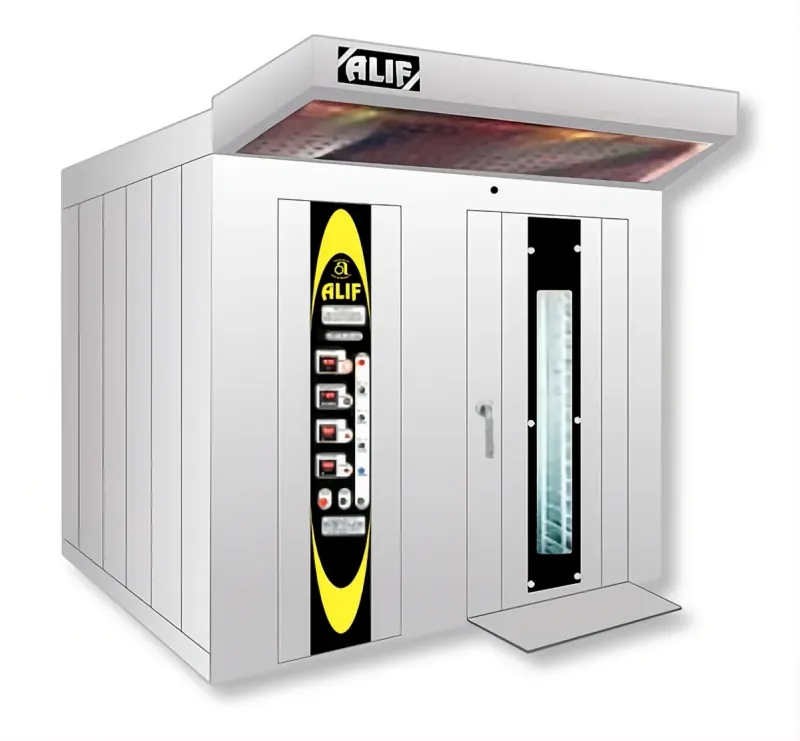
A rotary rack oven bakes in batches: you load a rack, the rack turns inside the chamber, and you unload when the cycle ends. So the question "which size" really means "how much product do I need per batch, and how many batches an hour can I run". Alif Ovens builds eight models, the AO-70 to AO-220, from a compact 15-tray oven to a four-trolley oven with 80 trays.
The Eight Models Side by Side
| Model | Rack | Trays | Tray size (in) | Bread per batch | Biscuits per batch |
|---|---|---|---|---|---|
| AO-70 | Compact | 15 | 18 × 18 | 80 loaves | 10–11 kg |
| AO-80 | Compact | 15 | 18 × 27 | 80 loaves | 16–17 kg |
| AO-90 | 1 trolley | 20 | 18 × 27 | 168 loaves | 22 kg |
| AO-110 | 1 trolley | 20 | 24 × 32 | 210 loaves | 22 kg |
| AO-130 | 2 trolley | 40 | 18 × 27 | 336 loaves | 44 kg |
| AO-170 | 2 trolley | 40 | 24 × 32 | 420 loaves | 62 kg |
| AO-180 | 4 trolley | 80 | 18 × 27 | 672 loaves | 88 kg |
| AO-220 | 4 trolley | 80 | 24 × 32 | 840 loaves | 124 kg |
Rusk and khari batches are in the same range: for example the AO-170 takes 60 kg of rusk or 38 kg of khari, and the AO-220 takes 118 kg of rusk or 76 kg of khari. Bun batches run from 224 buns on the AO-70 to 2,520 on the AO-220.
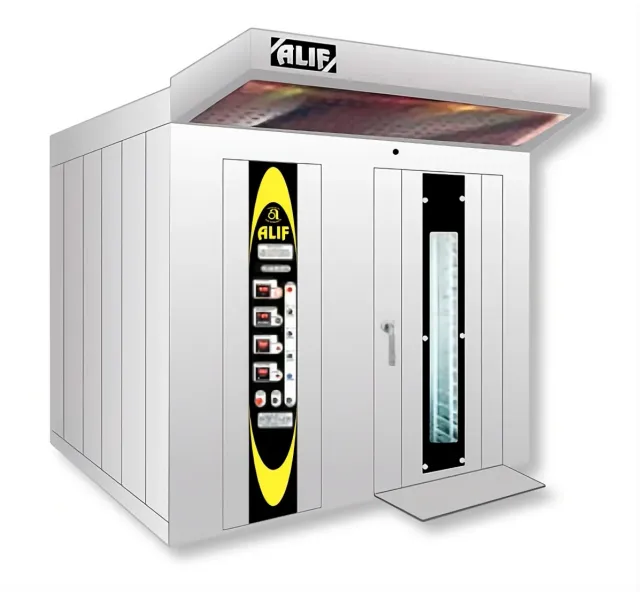
Space and Power
| Model | Overall size (in) | Motor power |
|---|---|---|
| AO-70 | 52 × 70 × 65 | 2HP + 0.5HP |
| AO-80 | 51 × 66 × 87 | 2HP + 1HP |
| AO-90 | 58 × 76 × 87 | 3HP + 0.5HP |
| AO-110 | 66 × 82 × 87 | 3HP + 0.75HP |
| AO-130 | 70 × 91 × 87 | 3HP + 1HP |
| AO-170 | 86 × 115 × 87 | 5HP + 1.5HP |
| AO-180 | 91 × 123 × 87 | 5HP + 1.5HP |
| AO-220 | 106 × 137 × 87 | 7.5HP + 2HP |
- Power: three-phase 440 V or single-phase 220 V
- Fuel: diesel, LPG, electric or wood-fired
- Heat-up: room temperature to 225°C in about 20 minutes
- Service access is from the front and top only, so the sides can sit close to a wall
- Delivered fully assembled or disassembled, which matters if the door or stairs are narrow
Bake Times Set How Many Batches an Hour
| Product | Bake time |
|---|---|
| Bread loaf (400 g) | 28–30 minutes (20–22 on the AO-70) |
| Buns (45 g) | 18–20 minutes |
| Biscuits | 14–16 minutes |
| Dry rusk, first bake | 18–20 minutes |
| Khari | 10–12 minutes |
The most batches an oven can run is 60 divided by the bake time in minutes, and loading and unloading take away from that. Treat the result as an upper limit and plan on fewer batches than it suggests.
A Worked Example
The numbers below are illustrative, to show the arithmetic. They are not a quotation.
| Step | Value |
|---|---|
| Target output | 100 kg of biscuits per hour |
| Batches per hour you plan for (illustrative) | 3, which leaves time for loading |
| Biscuit batch needed | 100 ÷ 3, about 34 kg |
| Models that fit | AO-130 (44 kg), AO-170 (62 kg) and larger |
| Models that do not | AO-90 and AO-110 (22 kg each) |
Choose a size above the minimum, not exactly at it, because demand tends to grow and an oven running flat out wears faster.
When a Rotary Rack Oven Is the Wrong Choice
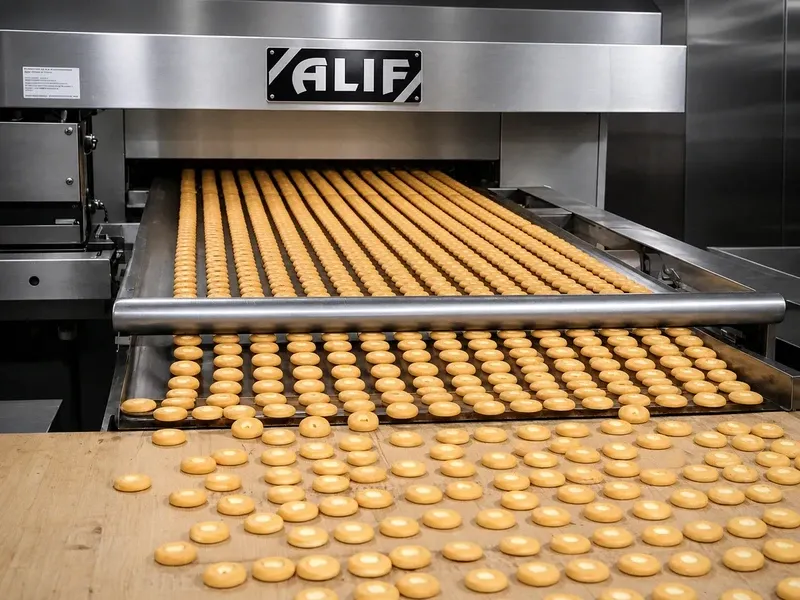
If you need continuous output at industrial volume, such as a biscuit or rusk line running all shift, a travelling oven suits better because product moves through without stopping. The guide to rotary rack ovens vs tunnel ovens compares the two, and the tunnel oven sizing guide covers belt width and length.
To get a recommendation, send your product, target output per hour, fuel and available floor space on WhatsApp at alifovens.com/whatsapp or to alif@alifovens.com. Alif Ovens usually replies with a recommendation and a written quotation within 24 to 48 business hours.
Talk to our engineers
Have a question about this?
Share your products, daily output target and floor space. We'll recommend a configuration and send a quotation.